 EU/UK
EU/UK
 US
US
 AU
AU

The question comes up in almost every conversation we have with warehouse operators considering a WMS change.
Should we stay on-prem, or move to cloud? And for years, the answer was genuinely complicated. Not anymore.
We have been implementing Infor WMS for a long time. James Gardiner has been doing this for over 25 years, across more than 50 implementations. Alex Gardiner has spent a decade working with Infor, moving progressively from on-prem to mostly cloud over the last four years. Between them, they have seen both sides of this argument play out in real warehouses, with real consequences.
This is not a vendor brochure. It is what they both actually think, based on what they have seen.
The Control Argument Is Not What You Think It Is
The most common reason we hear for staying on-prem is control. Companies do not want changes pushed to their system without their say-so. They want to be the ones deciding when something updates, and they want to be able to modify the system to suit how they work.
We understand that instinct. But it is worth being honest about what control on-prem actually means in practice.
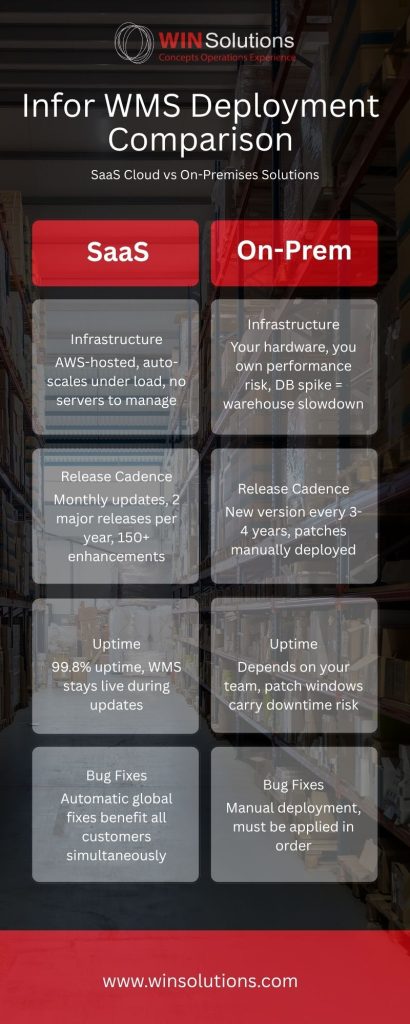
On-prem means someone in your business, or your IT partner, has to manually go into your SQL Server database and deploy patches. It means that when Infor releases bug fixes, you have to choose to deploy them, in the right order, or things break. We have all been in warehouses where the on-prem team is juggling bug fix 1, bug fix 2, bug fix 3, and if they go in out of sequence, the whole thing falls over. That is not control. That is complexity dressed up as control.
On cloud, you still have control. It is just administrative rather than technical. You choose when to enable new features through feature toggles. Nothing significant is forced on you. Since October 2024, Infor by default disables the monthly defect release if you have a specific reason to hold off. The difference is that the heavy lifting of actually deploying the change is done for you.
Of our current client base, roughly 30% are still on-prem and 70% are on cloud. The on-prem customers are not wrong for being where they are. But when we look at where the problems come from, they almost never come from the cloud side.
What Happens When Something Goes Wrong
On-prem, a performance problem is your problem. If someone does something that hammers the database, your warehouse slows down or stops. We have seen it happen. A barcode scanned into a quantity field, enter hit, and suddenly the site is grinding.
On cloud, AWS absorbs that spike. The same scenario happened at a customer site in Melbourne. The spike occurred, AWS flagged it, the team was alerted, and the warehouse kept running without missing a beat. That is a structural difference, not a minor convenience.
We are currently mid-rollout for Makita, and we are seeing sub-second RF response times in a large-scale operation. That is the infrastructure doing its job.
In terms of uptime, Infor WMS Cloud sits at 99.8% across 327 customers and 100,000 users globally. In four years of running cloud implementations, the significant incidents we can point to are a Cloudflare outage that degraded performance for about 30 minutes, and a brief Burst reporting outage. In the Burst case, Infor had someone on the phone with us within 15 minutes and it was resolved within the hour. For context, the Burst issues have not recurred in the last two releases.
We are not pretending cloud is perfect. It is not. But the failure modes are managed differently, and in our experience, they are managed better.
The Release Cadence Gap Is Wider Than You Might Think
On-prem customers typically receive a new version of Infor WMS every three to four years. In between, patches are made available, but deploying them is optional and manual. If you do not keep up with patches, you eventually find yourself so far behind that catching up becomes a project in itself.
On cloud, minor updates land every month. Major releases come twice a year, in October and April. In the last 12 months alone, Infor has shipped more than 150 new feature enhancements to cloud customers.
The on-prem RF screens, for instance, are still running a product called Trident, which came out of the Neptune system in 1997. Cloud RF is all HTML now. That is not a small gap.
There is also a compounding benefit to cloud that is easy to overlook. Because all cloud customers share the same core code, a bug that gets found and fixed for one customer gets fixed for everyone. You benefit from the entire global user base finding and resolving issues, even ones you have not encountered yet. On-prem, a fix only reaches you if you deploy the patch.
Customisation: The Honest Answer
On-prem gives you the ability to modify the underlying core code. For some businesses, that has been genuinely valuable. For most, it has created long-term problems.
On cloud, you cannot touch the core code. What you can do, through the Extensibility Toolkit, is change the presentation layer in ways that are far more extensive than most people realise when they first hear the constraint. Custom RF and mobile screens, colour-coded visual cues, user-defined fields with enforced rules, business rule triggers, REST API integrations, custom forms built from scratch using existing application procedures. None of that touches the core code, which means it survives updates cleanly.
We recently built a cycle count process for a customer that Infor declined to develop as a standard enhancement. We did it entirely in extensibility. It works, it is maintainable, and it did not require a code change. That is where the toolkit has landed after a few years of maturity.
Is it different from having full code access? Yes. Is the practical difference as large as on-prem advocates suggest? In our experience, not for most operations.

What Cloud Gives You That On-Prem Simply Cannot
Beyond the infrastructure and release arguments, there is a growing list of capabilities that are cloud-only, or so far ahead on cloud that the gap is effectively the same thing.
- The full Infor OS layer, including Data Fabric, document repository, and process automation tools that do not exist in the on-prem product
- AI and machine learning capabilities built into the platform, including pick path optimisation, slotting recommendations, and anomaly detection, all included in the platform cost without additional token charges
- The Velocity Suite for process mining and agentic automation, including converting emailed packing lists to ASNs, automated workflow monitoring, and contextual recommendations
- The enhancement request portal, where cloud customers can lodge and vote on product improvements that feed directly into Infor’s development roadmap
- Scalable storage through AWS – customers can expand from two to three terabytes, for example, and interrogate a full year’s transaction data without infrastructure changes
- Native voice picking via REST APIs, no longer limited to Vocollect, opening up lower-cost hardware options as the technology catches up
The AI piece in particular is worth watching closely. Twelve months ago we were talking about what AI in WMS might look like. Now we are getting certified on specific models, working with customers on pilot use cases, and seeing Infor invest heavily in building warehouse-specific AI rather than generic language models that do not understand how a DC actually works.
What Cloud Still Requires From You
We would be doing you a disservice if we left this out.
Cloud does not mean hands-off. After every update, you should still be running regression testing, particularly across your customisations, external interfaces, and reports. In our experience, the issues that come up are minor — a report column renamed, a configuration that behaves slightly differently — but they are real, and they need to be caught before they affect operations. Normally it is 15 to 20 minutes of work to resolve. Left undetected, it is a bigger problem.
Release notes need to be read by someone in your business who understands operations, not just the person who originally signed off on the contract. One of the simplest things we recommend to every cloud customer is to make sure the right people are set up to receive Infor’s release communications through Infor Concierge. It sounds obvious. It is consistently overlooked.
Cloud also asks you to think differently about change. On-prem encourages a mindset of stability above all else. Cloud rewards a mindset of continuous improvement. That shift is cultural as much as technical, and for some operations, it takes time.
So Where Does That Leave the Argument?
On-prem is not wrong. There are legitimate reasons to be there, and if your operation is running well on an on-prem deployment, we are not going to tell you to rip it out for the sake of it. We have customers in that position and we support them well.
But if you are making a decision today about where to go next, the gap between cloud and on-prem is no longer close. The infrastructure is more resilient. The release cadence means your system is actually keeping pace with the industry. The extensibility tools have matured to the point where most of what on-prem customers achieve through code changes can be done without them. And the AI and automation capabilities coming down the pipeline exist almost exclusively in the cloud environment.
The question we would put to any on-prem customer is a simple one: when your current system is next due for a major version upgrade, what are you upgrading to, and what will you be leaving behind?
That answer is increasingly pointing in one direction.
Thinking about where your WMS is heading? We are happy to have a straight conversation about it.
Get in touch with the WIN Solutions team below.